Cloud hosting explained in simple terms: it is a hosting solution that uses multiple interconnected servers to host websites instead of relying on a single physical machine. Unlike traditional hosting, cloud hosting distributes your website’s data across a network of servers, improving reliability and scalability.
If you’re learning about hosting options, this guide will help you understand how cloud hosting works, its advantages, drawbacks, and when to choose it over shared or VPS hosting.
What Is Cloud Hosting? (Cloud Hosting Explained Simply)
Cloud hosting is a type of web hosting where your website runs on a cluster of servers rather than a single server. These servers work together to ensure better performance and uptime.
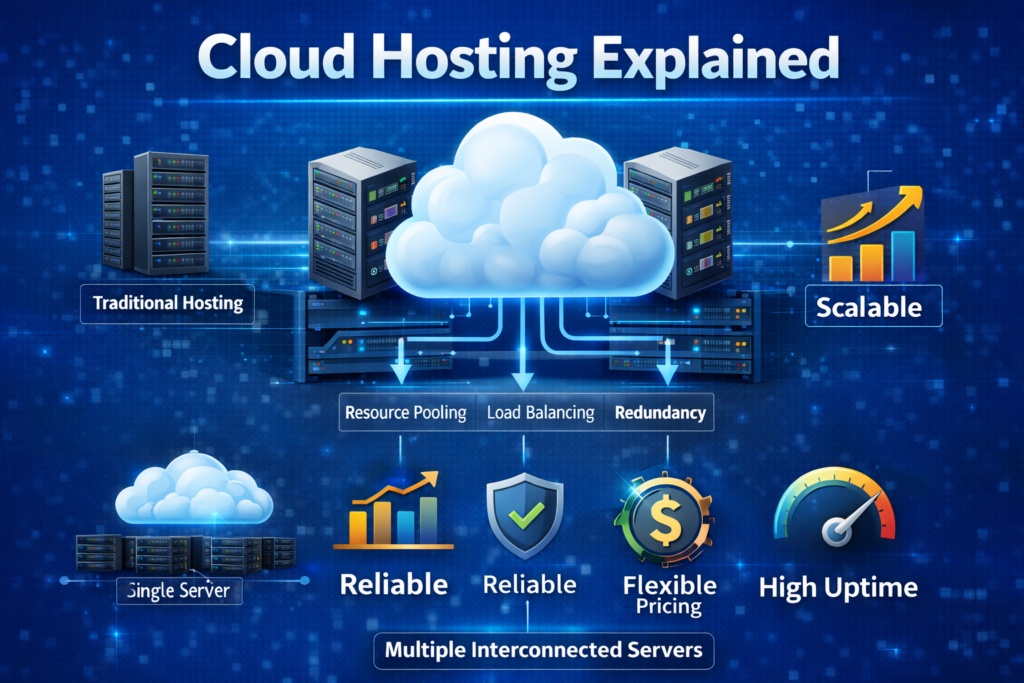
If one server fails, another automatically takes over. This redundancy makes cloud hosting highly reliable for growing businesses and high-traffic websites.
You can also read our types of web hosting guide to see how cloud compares with other hosting options.
How Does Cloud Hosting Work?
Cloud hosting works using distributed infrastructure. Instead of keeping your website files on one machine, they are stored across multiple servers connected through a network.
- Load balancing distributes traffic evenly.
- Redundancy ensures backup servers are available.
- Resource pooling allows flexible scaling.
- Virtualization technology powers server isolation.
Large providers like Amazon Web Services use this distributed cloud model to deliver scalable hosting environments.
Cloud Hosting vs VPS Hosting
Many users compare cloud hosting with VPS. Here’s a clear breakdown:
| Feature | Cloud Hosting | VPS Hosting |
|---|---|---|
| Infrastructure | Multiple interconnected servers | Single physical server |
| Scalability | Very high | Moderate |
| Reliability | High redundancy | Limited to one machine |
| Pricing | Usage-based or fixed | Fixed monthly |
For a deeper explanation, read our VPS hosting explained guide.
Benefits of Cloud Hosting
High Scalability
Cloud hosting allows you to increase CPU, RAM, or storage instantly as your traffic grows.
Better Reliability
If one server fails, another server in the network continues serving your website.
Improved Uptime
Cloud environments often provide excellent uptime because of their distributed architecture.
Flexible Pricing
Many cloud providers offer pay-as-you-go pricing models.
Ideal for Traffic Spikes
If your website experiences sudden traffic growth, cloud hosting adjusts automatically.
Drawbacks of Cloud Hosting
Can Be Expensive at Scale
While scalable, costs can increase quickly if resource usage grows significantly.
Complex Pricing Models
Some cloud providers use usage-based billing, which may be harder to predict.
Requires Technical Knowledge
Advanced configurations may require technical experience.
Who Should Use Cloud Hosting?
Cloud hosting is ideal for:
- SaaS platforms
- eCommerce websites
- High-traffic blogs
- Growing businesses
- Web applications
If you need scalable infrastructure, explore our cloud hosting plans designed for growing websites.
When Should You Choose Cloud Over VPS?
Choose cloud hosting if:
- Your traffic is unpredictable
- You need instant scalability
- Your website is business-critical
- You want high redundancy
Is Cloud Hosting Worth It in 2026?
Yes. Cloud hosting explained in today’s context means flexibility, scalability, and high availability. For businesses expecting growth or traffic spikes, cloud hosting offers better long-term stability compared to traditional hosting types.
- Load balancing distributes traffic evenly.
- Redundancy ensures backup servers are available.
- Resource pooling allows flexible scaling.
- Virtualization technology powers server isolation.
When Should You Choose Cloud Over VPS?
Choose cloud hosting if:
- Your traffic is unpredictable
- You need instant scalability
- Your website is business-critical
- You want high redundancy
Frequently Asked Questions
What is cloud hosting in simple terms?
Cloud hosting is a hosting solution that uses multiple servers connected together to host a website, improving reliability and scalability.
Is cloud hosting better than VPS?
Cloud hosting offers better scalability and redundancy, while VPS provides predictable fixed resources. The right choice depends on your needs.
Is cloud hosting expensive?
Cloud hosting can be cost-effective initially, but costs may increase depending on resource usage.
Can I host WordPress on cloud hosting?
Yes, cloud hosting is ideal for high-traffic WordPress websites.
When should I upgrade to cloud hosting?
You should upgrade when your website experiences rapid traffic growth or needs high availability.
Conclusion
In this cloud hosting explained article, we explored how cloud infrastructure works, its key advantages, and when businesses should upgrade from VPS hosting.


